

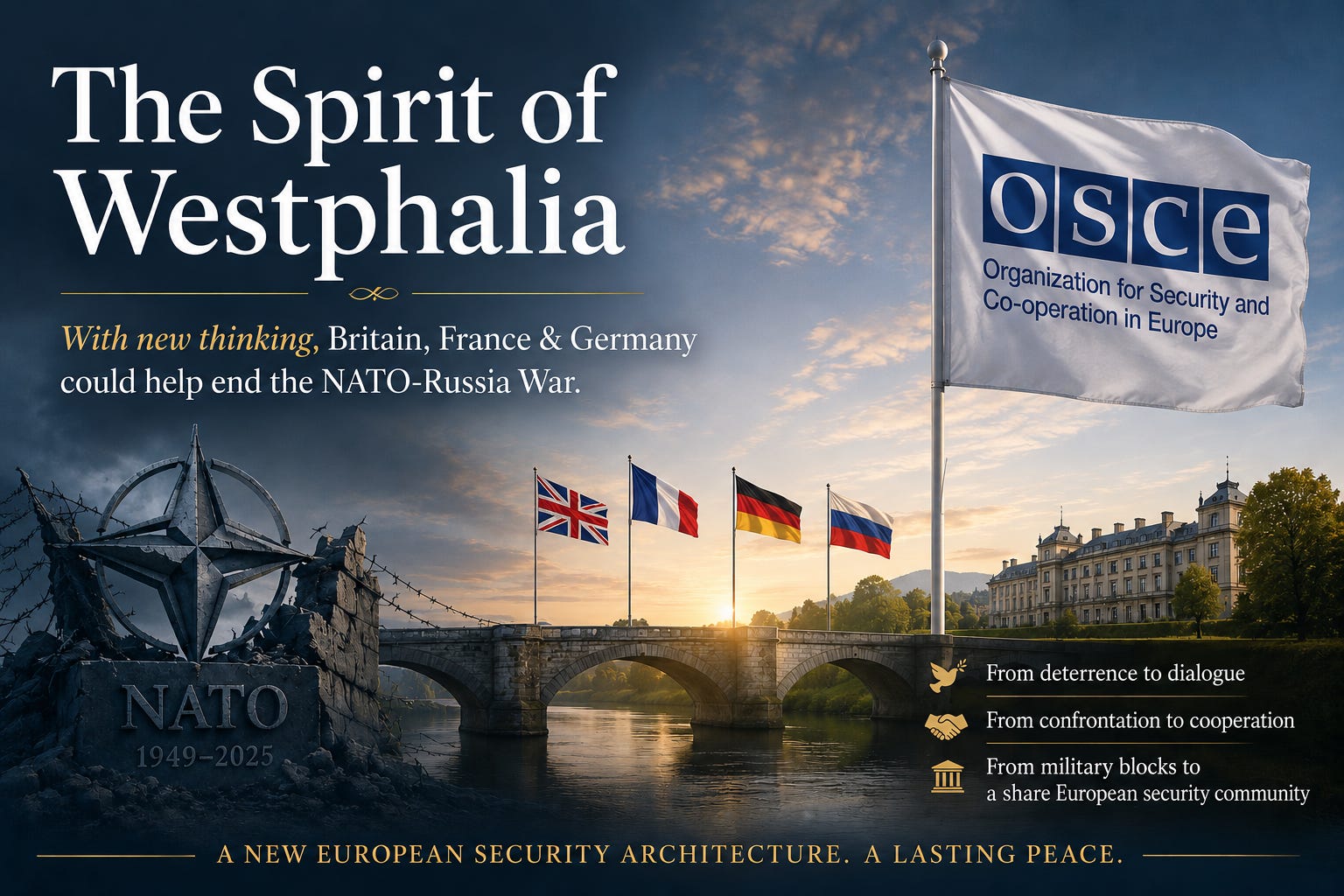
With changing political atmospherics, there is an opportunity for the E3 - Britain, France and Germany - to create a “coalition of the wise”, and help bring the NATO-Russia War to a close. Fresh thinking will be needed - including questioning the true value of NATO - but the prize could be long-term security in our common European home.
Introduction[1]
A simple observation explains much about the situation in the Russo-Ukraine War: Russia’s military operations have been guided by a winning military strategy; whereas NATO’s military operations have been guided by a losing political narrative.
The Americans, now with higher national security priorities – not least their own entanglement with Iran – have limited their engagement to providing intelligence support, indeed are looking for “new ideas” post-Anchorage. But, notwithstanding Russia’s deliberate but decisive success on the Eastern Ukraine battlefield, Europe’s institutions – NATO and the EU – and Kyiv itself are clinging to the political narrative they have created.
Based on their narrative statements, NATO, the EU and Kyiv seem determined to prolong the war. With seemingly little if any concern about the human costs to Ukrainians, the economic costs to Europe’s nation states, or the societal costs to Europe’s tax paying populations who are now expected to pay everything. In truth, NATO and the EU have become, with Zelensky, the primary obstacles to ceasefire negotiations. By deduction, they are also the primary obstacles to a goal that all of Europe’s peoples should surely want – a long-term sustainable European peace.
There could now, though, be a plausible alternative pathway to peace, if the European Three (E3), Britain, France and Germany are prepared finally and decisively to take over the reins from the US. And to agree – with other Europeans – what is best for Europe. The E3 will need carefully to diagnose the war’s cause and Russia’s real motivations. They may also need to examine the logic of West’s accepted pillars of European security, US engagement and NATO. They will then, subject to this analysis, need the courage to act in a way that NATO and the EU – captured by their own political narrative – cannot.
The War’s Nature
If Europe is to replace its incoherent – and ever-shifting – political narrative with a coherent strategy to guide its actions then, as General Carl von Clausewitz so wisely advised, intelligent diagnosis of the war’s nature is the first essential step for our political and military leaders.
The war is not an isolated event. Rather it is a symptom of an historically deeper cause, centred on the inadequacy of NATO’s security strategy. Which although described as collective security has in truth been one of confrontational security, masquerading as deterrence:
‘... NATO expansion was the touchpaper for the Russo-Ukraine War. The Russians warned us, time and again, that such expansion constituted a red line. So too did some of our very greatest strategic thinkers, starting with George Kennan in 1996, Henry Kissinger, Jack Matlock, even Bill Burns in his famous ‘Nyet means Nyet’ diplomatic telegram, and most recently John Mearsheimer with his 2014 forecasts. All ignored.’[2]
It is a simple but profound statement of the obvious that, based on events since 2022, NATO has failed to keep the peace in Europe. Put starkly, NATO has failed disastrously in its primary purpose.
Furthermore, there is a compelling historical argument that NATO’s confrontational strategy – and indeed it’s very post-cold war existence – was and still is the primary cause of the war, and thus a critical barrier to the war’s conclusion.
This article thus treats the conflict for what its diagnosed origins make it. Not a Russo-Ukraine War, but at root a NATO-Russia War. With Ukraine as the battleground on which NATO’s expansion and Russia’s long signalled response have collided.
The Strategic Context
The second essential step toward a coherent European strategy is to have a clear understanding of today’s strategic context, on which to chart our actions. Much has changed since February 2022:
· US National Security Strategy (NSS) – the Trump administration, operating in the US’s national interests, sees the European theatre as, at best, fifth on their priority list - behind the homeland, the Middle East, China and the Americas. A priority list that has, if anything, lengthened with America’s own unfortunate entanglement with Iran. What this means is that Europeans can no longer count on US engagement as a one of its two foundational pillars of European security. This may be uncomfortable for Europeans to acknowledge, but it is there in black and white in the NSS[3], for all to see. So, rather than seek to draw the US back into the war – which NATO, the EU and Ukraine are so transparently trying to do – it would be wise not to question America’s national security interests. But instead to seek to understand and accept these priorities, then work to be better aligned to them in a way that suits Europe’s own security interests. This is what it means to be true Atlantic friends.
· E3 Leadership – more recently the political atmosphere across all three E3 capitals may be starting to shift – in ways that could open the door to new thinking. In London, the new government under Burnham, elected on an explicitly domestic platform, has no explicit mandate for European security leadership. In Paris, Macron, whose own term is nearly over, has long maintained channels to Putin. In Berlin, Merz governs under mounting pressure, from a strongly polling AfD that includes in its manifesto re-engagement with Moscow. None of this guarantees a shift in E3 policy. But, with Starmer’s much vaunted “coalition of the willing” stillborn, the opportunity for new thinking is growing.
· Eastern Fortress Belt – on the battlefield, the key towns in Ukraine’s “fortress belt” are falling. In early July, Russian forces took most of Kostyantynivka. Zelensky’s response – sacking his defence minister and top military chief – is unlikely to change much and instead smacks of onsetting political crisis. I assess that Russia’s military strategy is now in its fourth phase of attritional offence, and that Russian advances will continue in the same deliberate way as recent months. But it would not surprise me if, after the fortress towns have fallen, military matters move more quickly. With Russia moving to a fifth phase of strategic exploitation, further intensifying the political and military pressure on NATO, the EU and Kyiv.
· Western Air Defence – as I set out in ‘Principles & Practice of Air Defence’[4], Ukraine’s skies cannot be defended by the West. Nor is this situation likely to improve in the next five years. But not only is Ukraine undefendable from the air, so too is Europe. Which should worry Europeans, when we have the E3 providing to Ukraine heavier missiles and drones that can strike deep into Russia. As I explained in ‘The Coming War with Russia’, were Russia to retaliate against E3 weapons manufacturers, not only would Britain, France and Germany be unable to defend against such retaliation, but nor could any other European state, as the US’s current setbacks in Iran unequivocally demonstrate. In the face of any Russia retaliation, the much-vaunted NATO Article 5 guarantee would be useless.
· Global Energy Shock – finally, and critically, Europe is facing an accelerating energy shock, which must inevitably lead to an accelerating economic shock. Even before the Iran war, Europe was suffering from the consequences of its own foreign policy, as European sanctions removed Europe’s access to cheap Russian hydrocarbons. With the closure of the Strait of Hormuz and the E3’s active support to attacks on Russia’s energy infrastructure by Ukraine – the latter a second European energy own goal – matters can only get worse. The economic consequence of which is that, notwithstanding the push by NATO and the EU for increased defence expenditure, there will soon be even less fiscal and political headroom for funding this war. A war that NATO is losing, a time when Europeans face for the second time in three years a ‘cost-of-living’ crisis, which in truth is simply a symptom of a ‘cost of energy’ crisis.
Taken together, these developments sharpen the choice facing Europe’s key actors. On the one side, are two institutions – NATO and the EU – each with their own institutional logics for prolonging the NATO-Russia War. On the other side, are the sovereign European nations, led by the E3, whose national interest is now clearly to bring the war to a close.
But for the E3 are to make a difference, we need a credible alternative to NATO and the EU’s current political narrative, the current foundation of which seems to be: “Double down and hope we can draw the US back into the war.”
The EU and NATO
The EU institutional interest in prolonging the war is likely one of political cohesion: a common foreign and security policy is one of the few genuine demonstrations of ‘ever closer union’ and a negotiated peace on Russia’s terms could be read, fairly or not, as a defeat for that project. But Russia is relaxed about the EU. So, other than providing insights into why von der Leyen and Kaja Kallas are strong advocates for prolonging the war, the EU’s view matters little.
Whereas Russia sees NATO as an existential threat. Those pundits who suggest that Russia has nothing to fear from NATO miss the fundamental point. It doesn’t matter what the pundits think. It matters what Russians think.
For NATO, arguably the institutional interest is also existential: an alliance built for a bipolar confrontation needs a live confrontation to justify its budget, its structure, and its post-Cold War expansion. But NATO as an institution has a post-Cold War track record that is less than stellar. First, offensive operations against Kosovo were launched without a Security Council Resolution and using a legitimacy logic less convincing than Russia’s SMO justification. Next, after near two decades fighting against a rag tag Taliban insurgency armed with Kalashnikovs and IEDs, NATO lost in Afghanistan. Then, in February 2022, not only did NATO unequivocally fail to prevent war in Europe, the historical evidences suggests that NATO’s Eastern expansion was the cause – the foreseeable cause – of the war. Finally, as I explained in January 2025, NATO is a now military shadow of its former self and could not win a conventional war against Russia – nor is this likely to change without significant and sustained investment over the next 10 years. As I have said previously:
‘The truth is that NATO now exists to confront the threats created by its continuing existence. Yet … does not have the capacity to defeat the primary threat its continuing existence has created.’[5]
On this basis, the logic for having NATO as the second foundational pillar of European security deserves, at the very least, intelligent and clear-eyed scrutiny.
As importantly, it is not just NATO’s failing track record that warrants scrutiny, but also the live matter of how the NATO-Ukraine War – where the balance of regional military power now decisively favours Russia – is ended. The fundamental point is this: even with the US onboard, NATO’s chances of militarily imposing on Russia the ceasefire conditions currently sought by Zelensky and Europeans would have been extremely slim; without the US, the chances of any future European ‘coalition of the willing’ are nil. America’s policy - no Ukraine in NATO, no US forces on the ground, no NATO peacekeeping mission, no Article 5 guarantee, no US ‘backstop’ - reflects this truth.
The logical deduction seems clear. Unless Europeans wish to continue sending good money after bad, whilst at the same time risking a catastrophic Russian retaliation against which they have no defence, we have no other intelligent option than to accept the realities on the ground. Russia will retain the lands controlled by the Russian Army. Any negotiated peace must – largely – accept Russia’s long-stated ceasefire conditions, in which NATO has no role. This is not a concession to Russia but to realpolitik.
NATO’s Future Role
But, led by the E3, in approaching negotiations with Russia. Europe could go further. Much further. Drawing on our earlier diagnosis of the war, a first radical – but logical – measure would be jointly to examine the fundamental question of NATO’s future.
The Russians have made clear that NATO can have no role in Ukraine after a ceasefire. Furthermore, even if confrontation masquerading as deterrence were a good principle, NATO does not have the military or industrial or energy capacity to make good on this approach. So, after a war that NATO failed to prevent, and given that it is unlikely in any meaningful timescale and at any realistic level of fiscal investment to defeat the threat that its continuing existence has created, what will be the point of NATO?
Whatever the answer, it is now surely obvious that NATO cannot guarantee future security in Europe? Yet security in Europe is surely what all Europeans want? Including Russians?
Well, yes – this is exactly what Russians want. Because they have told us just this. As a recent example, in June 2026, ‘Ukraine, Europe and Global Security’[6], Lavrov argued that any durable settlement would need to rest on legally binding mutual security guarantees rather than political commitments. He explicitly cited the founding principle of the Organisation for Security & Cooperation in Europe (OSCE) of the indivisibility of security as a foundational basis for a pan-European order. In other words, as well as there being a potentially opening door in the E3 to new thinking, there is on the other side of the conflict a door already ajar, with an implicit invitation for Europeans to walk through it – as, reportedly[7], some already have.
An Alternative Pathway to Peace and pan-European Security
If we are to work through a sustainable NATO-Russia peace settlement, and toward long-term pan-European security, we will need at least three things. First, there will need to be a commitment to new diplomacy by European leaders – even if conducted whilst operations continue, which is not of itself unusual in war. Second, we will need to develop a general framework for peace talks, a framework constructed by all the parties to the conflict. Third, we will ideally need the support of an organisation or organisations that could facilitate such a process. By historical good fortune, the OSCE headquartered in neutral Vienna, is a plausible alternative. Not least because Lavrov has already cited its founding principle as key to pan-European security.
Here, then, is the opportunity for Britain, France and Germany to bring new thinking to the table. To make an explicit offer to reengage diplomatically with Russia, and work with Russians and Ukrainians to develop an alternative pathway to long-term European peace. Working through the good offices of the OSCE – an OSCE perhaps strengthened for this purpose by investment of time, people and money from all sides of the conflict.
This will not be easy, quite the reverse. It will take diplomatic commitment and time and effort and perseverance and patience and by Europeans and Russians – perhaps with American support but perhaps not – to formulate such an approach. But some potential components give a sense of how such a successful framework could be constructed:
· Security Cooperation – an agreed philosophical and strategic mindset shift from confrontation to cooperation, based on the indivisibility of security in our common European home.
· Security Guarantees through Neutrality – with the US unwilling, and Europe too weak, to provide meaningful security guarantees or backstops the only viable alternative for Ukraine is neutrality. Drawing on the 2022 Istanbul accords, an Austrian or Swiss model would be a good starting point.
· Confidence Building Measures – another important step in rebuilding trust. Russia has made clear there will never be NATO country ‘peacekeepers’ on the ground in Ukraine. But ‘observers’, for example drawn from non-NATO OSCE nations, could be a different story - especially if acting, early in the peace, to verify that agreed Ukrainian movements toward neutrality are underway.
· Arms Control – conventional arms control treaties will take significant diplomatic effort to craft. But the idea of Britain, France and Russia examining options to re-invigorate the nuclear arms control treaties could be a quick win-win — and allow all of human society to begin to breathe more easily.
· NATO – an offer by the E3 nations, ideally with support of other European nations, to review – with Russia – NATO’s future purpose and roles. Including, if this made sense, the idea of extracting those NATO capabilities that could have some future utility in the furtherance of pan-European security – maybe integrating them into a rejuvenating OSCE – and gracefully retiring the remainder with no such utility.
· Economic Cooperation – the release of all Russian foreign monies and the cessation of all economic sanctions would be a final quick win-win. Not only as an important signal to Russia, but also for the benefit of European people. Who, in stark contrast to Russian companies and consumers still benefitting from stable, cheap energy prices, are suffering the consequences of British and EU sanctions’ boomerang impacts on European economies.
For the clear sighted, the potential advantages are manifest. For Russians, removal of their primary security threat. For Americans, the end of its European NATO political and financial burden. For Ukrainians, closure on the NATO membership question, the end of a disastrous war, and security through neutrality. For Britain, France and Germany – and the smaller European nations – a chance to ‘step down’ from a losing war, from an unwinnable arms race, and from accelerating socio-economic impoverishment.
Conclusion
In 1648, after years of protracted and difficult diplomacy, the Treaty of Westphalia was signed, ending the 30 Years and 80 Years wars – establishing the principles of diplomacy we recognise in international law today and ushering in a period of relative peace that lasted for well over a century. Westphalia’s genius was not only diplomatic, but also conceptual. It established sovereignty itself – the right of a state to determine its own affairs, free of external dictation – as a foundation of international order. That is the principle this moment calls for again. In this case, a conscious agreement to shift from a strategic philosophy of zero-sum confrontation to one of non-zero-sum cooperation.
With Westphalia as inspiration, this is the time for Britain, France and Germany – for Andy Burnham in London, Emmanuel Macron in Paris, and Friedrich Merz in Berlin – to have the political and moral courage, as Americans have already had, to look at the NATO-Russia War from Russia’s perspective. To question long held but increasingly dubious military-security foundational ideas on NATO’s utility. To be prepared, subject to that re-examination, strategically to pivot.
Away from an explicitly confrontational security strategy, by decommissioning a failed, bloated and unredeemable NATO. Toward a cooperative security strategy, perhaps delivered through an empowered and reinvigorating OSCE, working toward a shared goal of long-term peace in our common European homeland.
[1] This article was originally drafted in March 2025 but thought to be too radical for the outlets to which I offered it. I hope that times have changed sufficiently for it to appear less radical and more rational.

[3] https://www.whitehouse.gov/wp-content/uploads/2025/12/2025-National-Security-Strategy.pdf
[6] Sergey Lavrov, ‘Ukraine, Europe and Global Security’, Russian Foreign Ministry, 19 June 2026. Declined for publication by Politico Europe.] Full text at: globalsecurity.org/wmd/library/news/russia/2026/06/russia-260619-russia-mfa01.htm
[7] In July 2026, Bloomberg reported that former British National Security Adviser Sir Tim Barrow, former German State Secretary Markus Ederer, and veteran French diplomat Pierre Vimont met secretly in Vienna with a former Kremlin official to explore conditions for peace talks - a Track II initiative organised by the Centre for Humanitarian Dialogue. Bloomberg, ‘European and Russian Ex-Officials Held Talks on War in Ukraine’, 5 August 2026. bloomberg.com/news/articles/2026-08-05/european-and-russian-ex-officials-held-talks-on-war-in-ukraine.
Admirable proposal. It is well past time that the commentariat made constructive proposals for peace. Thank you. I had a couple of other perspectives to throw into the mix of new thinking.
People draw many lessons from Westphalia, and I am inclined to emphasise some different points to you. Many historians doubt the view that it established the principle of national sovereignty or secured peace for that long. To me the model of the Peace of Westphalia was multiple coordinated agreements, multilateral processes including congresses, inclusive dialogue, and the curbing of hegemonic role of the Habsburg Empire. You capture some of this in your principles. Today's equivalent of the Habsburg Empire is the USA.
I would rely less on the E3 - especially given Britain's belligerence towards Russia/Soviet Union, well since at least 1917 - and place more emphasis on reconciliation with the Eastern and Central European states. I also believe both the USA and Britain need to be kicked out of continental Europe, including those British territories in Cyprus and Spain. Tarik Cyril Amar has assessed that the AfD's friendly rhetoric towards Russia will not last. Don't place hope in them. The EU needs to be embraced as a full party to the war and partner for peace, and allow the internal, institutional leadership transitions to occur. I would rely on the UN rather than the OSCE especially given the global implications of the war.
NATO - that is the USA primarily - has created a mess in Ukraine and Europe that has affected the whole world. Unfortunately the world not just the E3 will have to clean it up. And the USA needs to really stop its aggression towards Russia in Ukraine and everywhere. not just in Europe.
I hope the article stimulates more proposals for a robust peace process. I know the TFF and I proposed one late last year, and I have been inspired by your piece to dust it off and update for the situation.
Thank you Steve. A superb analysis with a pointer to a secure and peaceful Europe.
Wisdom was never more badly needed.
Need to get this into the inbox of every politician, military leader, and business leader in Europe and to disseminate as widely as possible within European civil society.
The Soviet Union is no more; the Russian Federation seeks peace, security and prosperity; NATO in Europe is well past its sell-by date and all it has achieved is creating an adversary that it is unable to engage militarily while pauperising Europe's Citizenry in the process. Time to wake up and to wisely address reality - EurAsia is the future - time to join it properly.
Keep up the good work.