

1. Executive Summary
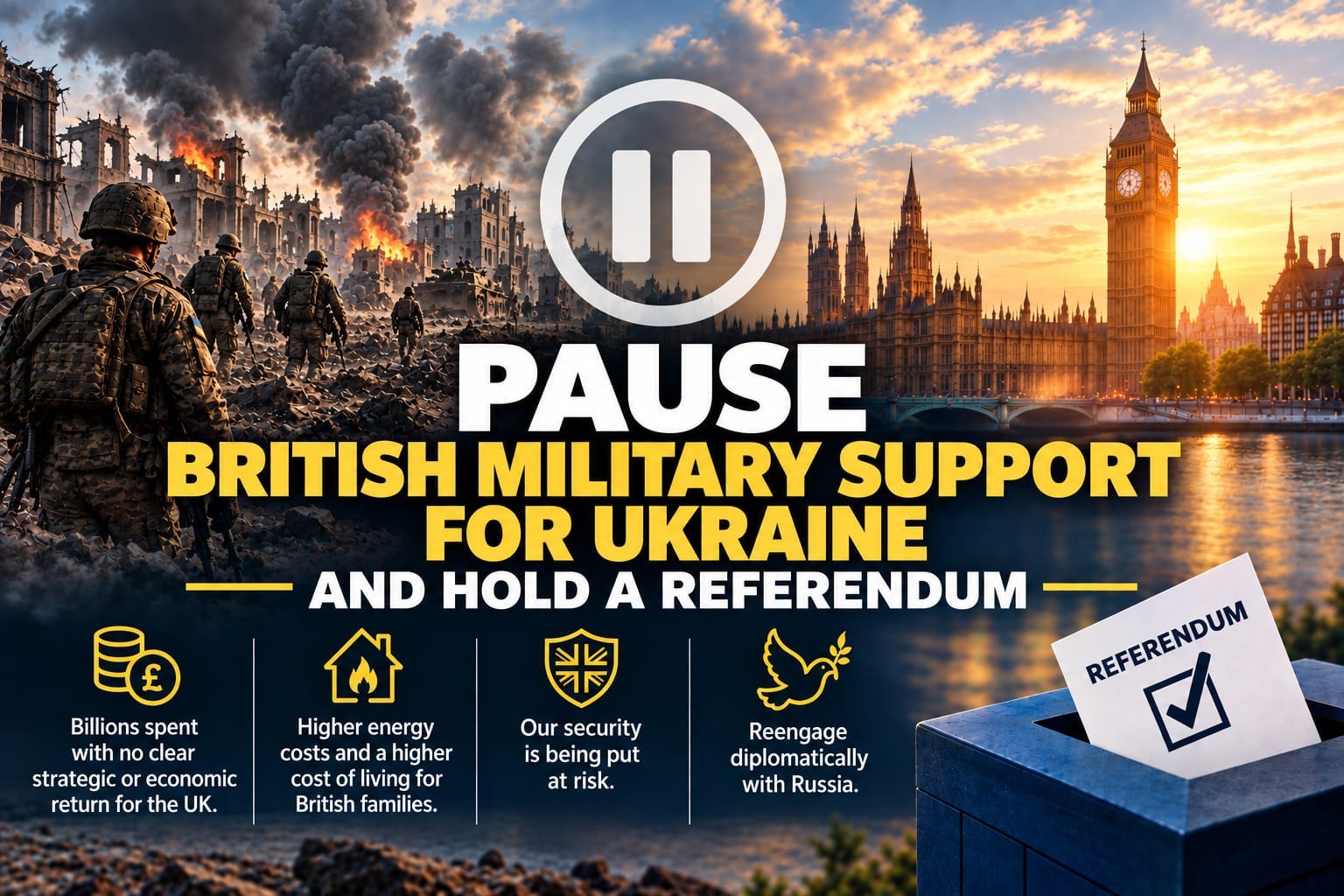
Moscow has warned that British military targets in Ukraine and “beyond its borders” could be struck in response to Ukrainian attacks using British-supplied weapons. With Britain drawn ever deeper into the war, that warning should be taken seriously. Britain has pledged £25 billion since 2022, with a further £3 billion a year committed to 2030/31, yet its bases, ports and energy infrastructure are almost wholly undefended against Russian long-range missiles such as Oreshnik. Meanwhile, the military picture is moving against Ukraine, while Western diplomacy has stalled and Western policy relies on escalation through deep-strike weapons. I have therefore signed this particularly timely petition and urge British citizens and UK residents to consider doing the same, not because one necessarily agrees every word of it, but because a policy carrying such financial, military and escalation risks deserves independent scrutiny and full debate in Parliament.
2. Introduction
On 27 August 2026, Moscow issued one of its starkest warnings yet that British military installations and equipment in Ukraine and “beyond its borders” could become targets in response to Ukrainian strikes using British-supplied weapons. Russia’s Foreign Ministry spokeswoman warned of “inevitable catastrophic consequences” unless Britain changed course.
The context of these warnings is critical. First, although I cannot prove it, I strongly suspect that British service personnel have been directly involved in war-fighting against Russia, in particular through the provision of targeting data for British-supplied missiles and through operations against the Russian Black Sea Fleet. Second, although only two British service deaths have been announced during the campaign, my independent media sources suggest the true number runs well into double figures.
So, to dismiss Russia’s warnings as not serious – as some British politicians and commentators have – seems to me foolish. We surely need a full and frank political – and public – debate. How far is Britain becoming a participant in this war? What are the risks? What will the policy cost? And has Parliament properly examined the answers against independent evidence? I believe it has not.
3. Petition
A petition has been launched https://petition.parliament.uk/petitions/781311#action, which I have signed because I believe it is particularly timely. Its text reads:
Pause military support for Ukraine and hold a referendum
The government has spent billions supporting Ukraine in the conflict. We believe this has no strategic or economic interest to the UK and that it’s adversely affected the cost of energy and of living. There should be a pause in the policy until there is a national debate and referendum on the issue.
We believe the UK should have remained neutral in the conflict in 2022. There have been many casualties since then on both sides. The UK has officially given Ukraine £16bn in military support and we think now the government is risking British security by its support for Ukraine. Some of the sanctions and policies against Russia have also contributed to the major rise in energy and cost of living costs since the conflict began.
Although only British citizens and UK residents can sign it, the petition nevertheless offers an opportunity to raise the profile of this issue in one of the E3 (Britain, France and Germany) nations and, until Keir Starmer’s departure, a co-leader with France of the so-called “coalition of the willing”.
4. The Policy Position
An independent assessment of the status, costs and risks of UK policy needs to be made and laid before Parliament for debate. There are two serious cases to be made, and both deserve a hearing:
· The Government Position – the first, the government’s, holds that aggression must not be rewarded. On this view, Russia’s initiation of its Special Military Operation (SMO) was an unwarranted aggressive act. If Putin isn’t stopped in Ukraine, all Europe is vulnerable. Thus, our security depends on Ukraine’s survival, and Britain’s support should be “for as long as it takes”. Ukraine has already exacted a heavy price from Russian forces and, increasingly, from a failing Russian economy.
· The Realist Position – the second holds that the war’s antecedents lie in the end of the Cold War, when Russia was assured that NATO would not expand. The primary cause of the war – as Russia and some of the West’s greatest strategic thinkers warned – was the relentless expansion of NATO in the face of repeated Russian warnings. Russia is fully mobilised for this war and is mobilising industrially for a defensive war against NATO – one it does not want to fight but will be ready to fight should NATO escalate.
As well as being the instrument of Britain’s participation in the war, the Ministry of Defence (MoD) is also a principal source of advice to Parliament and the principal advocate of the first view. Yet, for a decision of this magnitude, Parliament and the public should also have access to independent analysis.
It seems to me that the purpose of this petition is not to predetermine the answer. It is to ensure that Parliament and the British people are properly equipped to debate the question.
5. The Campaign Status
The Western line is that, thanks to continued NATO support, the military situation is one of stalemate and, if the forthcoming 22nd EU sanctions package is effective, Russia will be forced to the negotiating table to accept conditions that suit Ukraine and the West. Independent analysts – former military, intelligence, and political professionals – on both sides of the Atlantic and in Australasia have arrived at a different view.
On the Eastern front line, the Russians are close to seizing the last of the fortress cities, behind which Ukrainian defences are thin. The Ukrainian Army’s manpower situation is increasingly difficult, with Kyrylo Budanov – formerly head of military intelligence, now head of the Presidential Office – saying in late August that at least 30,000 people must be mobilised each month. The programme of ‘busification’ – a term for what is, in truth, the violent press-ganging of Ukrainian men of fighting age – is causing increasing unrest, not least amongst the mothers, wives, brothers and children of those taken.
In the skies, although not fully watertight, Russia’s integrated air defence has reduced the effectiveness of Ukraine’s deep-strike attacks. By contrast, there is minimal defence – none – in the skies above Ukraine against Russian saturation attacks combining drones with conventionally armed ballistic and hypersonic missiles. The consequences for Ukraine’s economy – essentially now on European life support – are profound, whereas Russia’s is stable, indeed much more so than Western economies thanks to its very low debt-to-GDP ratio of around 17%.
Critically, the European Governments have refused to re-engage diplomatically with Russia, and NATO’s only response to mounting evidence of Ukrainian military failure is to “double down and hope” – largely through the provision of deep-strike weapons to Ukraine – while ignoring Russian warnings about their use, notwithstanding that NATO has no effective defence – none – against the retaliatory strikes Russia has threatened.
6. Costs & Consequences
“So what?” for Britain. The government’s fiscal commitment is, and remains, considerable. The UK has pledged £25 billion since February 2022, of which £16 billion is military assistance. In July of this year, the Prime Minister has committed £3 billion a year in military assistance “for as long as it takes”.
The costs are relatively straightforward to forecast. The UK has committed £3 billion a year in military support until 2030/31. On current commitments, that represents roughly another £15 billion before reconstruction, additional military expenditure or any future reassurance force are included.
The risks are harder to quantify and get to the heart of the matter. Britain does not possess a ballistic-missile defence system comparable to Israel’s – and even Israel’s layered defences, including Iron Dome, have been penetrated by a lesser military power than Russia. Indeed, in July, General Sir Richard Barrons told the Defence Committee that UK investment would largely improve warning of attack rather than provide the means to stop it.
Russia, meanwhile, has used the Oreshnik intermediate-range ballistic missile. Its second reported strike, in January 2026, hit critical infrastructure near Lviv, approximately 70 kilometres from the Polish border. Were Russia to choose to retaliate, or a NATO–Russia war begins, Britain’s military bases, dockyards, onshore power and oil and gas infrastructure, and ports would be all but defenceless. As I explained in The Coming War with Russia[1], the societal and economic consequences of such a war would be profound.
7. Conclusion
Of course, not every war can be prevented by debate. But now, as in 1914, the very absence of debate is itself a risk when decisions carry potentially catastrophic and irreversible consequences.
No one who signs this petition needs to agree with all of its opinions, only to accept that a policy, carrying potentially enormous financial, military and escalation risks, deserves independent scrutiny by the Parliament accountable for it and by a people who will ultimately have to pay its costs and live with its consequences. As I wrote in my post The Coming War with Russia[2]:
To conclude, before they march us onwards towards war, our leaders owe us two things. First, an honest, public, strategic assessment of the risks to which this course of action could expose us. Second, an opportunity for our views to be sought and our voices to be heard. After all, it is we, not they, who will be the ones expected to fight the war and bear its costs and consequences.
The choice we Europeans face is simple. Should we change course toward peace, and begin a difficult but honest diplomatic conversation with Russia? Or should we let our leaders – guided by a political narrative that they have constructed and ignoring the existential risks set out here – continue to lead us onwards towards war? As did their illustrious predecessors, a century or so ago, in the Summer of 1914?
If you are a British citizen or UK resident, please sign and, as importantly, please share:
https://petition.parliament.uk/petitions/781311

[2] Ibid.
[2] Ibid.
[C1]Suggest hyperlinking your earlier post here.
Stuart, I will always be respectful of the alternative views, its essential if one is coming at the matter using strategic thinking, which I do. The key observation though is on evidence - in that there is no evidence whatsoever that Russia wants to regain its FSU territories, or indeed take over all of Ukraine. There is a lot of opinion, indeed overwhelming volumes, based on interpretation by the commentariat of Russia's intentions - but no evidence, none. Turning to Kremlin propoganda, when I see statements such as this I immediately think this is line of argument is essentially: "Play the man, not the ball". I'm occassionally called a Putin sympathiser, no doubt some will say I'm a victim of Kremlin propoganda. But the truth is that I rely on a balanced assessment of the facts that I can see on the ground, and a judgement of which of the many, often conflicting, analyses best fits these facts. I have found my best sources are people like me, former military, intelligence or diplomatic professionals. This is not to say they are all right, but rather to say that their insights seem to best fit the facts. I think its a shame that you don't want to entertain a debate on a matter of such profound importance to the UK - my article The Coming War with Russia sets out potential costs and consequnces - but we are of course a democracy, so I'm respectful of your decision.
Petition signed.