
Mor Gallos - Founder's Letter
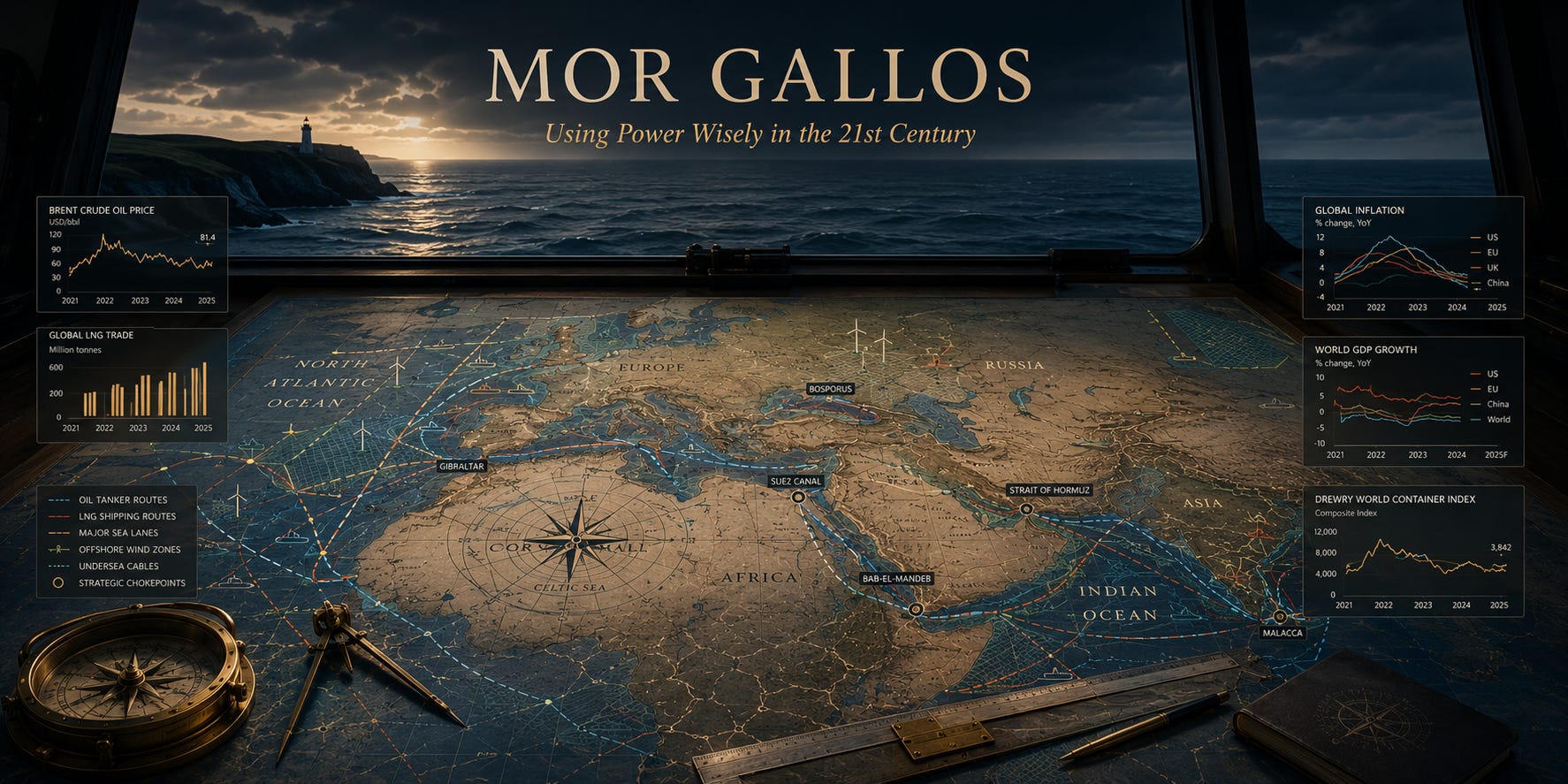
Mor Gallos means “Sea Power” in Cornish, which is the Celtic language of Cornwall, a county in Britain’s far South West.
I live in a small village close to Falmouth, home to the world’s 3rd largest natural harbour. The name Mor Gallos felt right - not only because of my own part-Celtic ancestry, but also because of what the sea represents to me, as a long-time professional seafarer: a medium of power and danger, of trade, of connection, and of consequence. These themes underpin my thinking.
I am writing to introduce myself and to explain what this Mor Gallos Substack is, why I launched it, and what I hope you will find here. If you have arrived via the podcasts of my friends and colleagues in the alternative media – such as Daniel Davis, Glenn Diesen, Pacal Lottaz, Ian Proud or others – or via my own (soon to be launched) Strategic Arena YouTube channel, or simply by searching for serious analysis of the crises now reshaping the world, I am glad you are here. I will try to reward your attention.
Let me say directly who I am and where I come from analytically, because it matters.
I spent the first thirty-four years of my career in the Royal Navy, often on the front line of geopolitics. As a young naval aviator, my very first operational deployment was to the Falklands War flying from HMS Invincible. As a senior naval officer, my final operational deployment was to Afghanistan as Strategy Director in the British Embassy in Kabul. In the intervening years, I commanded ships and a destroyer squadron at sea, led British naval aviation as Commodore Fleet Air Arm, served in four Whitehall appointments in Britain’s Ministry of Defence. These Whitheall appointments included working as Deputy Director of the Policy Planning Staffs formulating defence policy, and Principal Staff Officer to Britain’s Chief of the Defence Staff, operating at the highest levels of Britain’s defence and security establishment. I also spent more than a decade thinking professionally about strategy, force, and the utility – and severe limitations – of using military power for coercive purposes.
My first book, Strategy for Action: Using Force Wisely in the 21st Century, published in 2011, was based on these experiences. Its central argument is that military force is a tool of strategy, not a substitute for it, and that its application requires rigorous thinking about ends, ways, means – and about war’s unintended consequences. My thinking was shaped by, amongst other things, experiencing - sometimes at the closest of quarters – the consequences of policy and strategy made well. And of policy and strategy made badly – particularly badly by the West in its wars and interventions of the 21st century.
The fifteen years that followed took me into offshore energy, both offshore renewables and offshore oil & gas. I worked for a number of offshore energy companies – Mojo Maritime Ltd, James Fisher Group, Wave Hub Ltd – finishing with Celtic Sea Power Ltd, where I served as CEO until March 2026, leading the industrial development of floating offshore wind in the Celtic Sea region, off Britain’s South West coast. Along the way and whilst Chair of the Celtic Sea Cluster, I authored Britain’s first regionally integrated offshore energy master plan, offering regional direction to the Celtic Sea floating offshore wind industrial development programme. Energy, in other words, is not an academic interest for me. It is a domain I have operated in, at senior level, for over a decade and a half.
My educational background spans Applied Mathematics and Physical Oceanography at Bangor University in Wales, International Relations and International Economics at Pembroke College, Cambridge University, and strategic training at the Royal College of Defence Studies. I also a Chartered Marine Technologist and a Fellow of both the Nautical Institute and the Institute of Marine Engineers, Scientists and Technologists. I mention these not as credentials for their own sake, but because they define the analytical lens I bring to the writing that you will find here: scientific where the evidence demands it; strategic where the complexity requires it; but above all, always anchored in the physical world rather than the abstracted models that all too often pass for analysis.
Mor Gallos exists because I believe we are living through a period of genuine historical rupture – in very large part because of developments, many unseen, in the world of energy – and that the conventional analysis available to most readers, be it geopolitical or macro-economics, is not adequate to explain what is happening.
The Russo-Ukraine War has been grinding for over four years and has not produced the swift Ukrainian victory that much Western commentary predicted. Gulf War III — my shorthand for the US-Iranian confrontation — has disrupted some fifteen percent of global oil supply and twenty percent of global LNG in ways that conventional macroeconomic models were not designed to handle. The two conflicts are not separate events. They are interlocking components of a single systemic shift: the end of the unipolar moment, the fracturing of the alliance structures that sustained it, and the emergence of a world in which energy, military capability, and economic power are being redistributed in ways that will define the next generation.
I have spent the past decade developing a new analytical framework I call macro-energetics. Its central proposition is that energy flows are not merely an input to economic activity but its physical substrate. Its central advantage is that, by analysing these flows rigorously it is possible to produce macroeconomic forecasts that are consistently more accurate than conventional macro-economics and can lead conventional macro-economic forecasts by three or so months. The implications of the insights that this framework offers — for inflation, for currency markets, for food security, for the political sustainability of the wars now being fought — are significant and largely unreported in mainstream analysis. My forthcoming book Energy Realpolitik: Using Power Wisely in the 21st Century sets out the full argument. Mor Gallos is where I develop and test the ideas with my readership here, in real time.
What will you find here?
Three things, initially.
First, I will build a reference library of Strategic Thinking 101 Essays. These will explain the strategic analysis framework that I use, drawing on Strategy for Action: Using Force Wisely in the 21st Century and articles that followed its publications. It seems to me that, all too often, writers and analysts on Substack, YouTube and other outlets focus on the strategic moment, but offer little if any background material for readers’ or viewers, educational reference. I want to correct that, and to help my readers think strategically.
Second, I will provide Contemporary Strategic Analysis of the major conflicts and geopolitical developments now reshaping the global order — not hot takes or commentary, but structured assessment: what is actually happening, why it is happening, what the principal actors are trying to achieve, and what the evidence suggests will happen next. I am particularly interested in the Russo-Ukraine War and Gulf War III, but also on the broader architecture of great-power competition — US-China tensions, the fracturing of NATO, the emergence of the multipolar world — and on the economic and energy dimensions that most geopolitical analysts treat as secondary when they are, in fact, primary.
Third, over time, I will introduce the key foundations that underpin the macro-energetics concept. And then use this to provide Contemporary Macro-Energetic Analysis applied to current events: explicit, dated predictions derived from the framework, published publicly, tracked, and revisited when the dates arrive. I am aware that making verifiable predictions is a higher-risk analytical strategy than the hedged commentary that dominates most publications in this space. I am doing it deliberately. My framework either works or it does not, and the only honest way to find out is to test it in public.
On what this publication is not.
In Mor Gallos, I do not follow a particular political line or take a particular ideological position. Be it left or the right, pro-Western or contrarian. Not least because, in my experience, analysis overly determined by political or ideological thinking is all too often flawed.
My interest here is in what is actually happening and why. Readers looking for validation of an existing political or ideological position may sometimes find it in my writing, but sometimes find the opposite. That is as it should be.
I do not give financial advice and am not licensed to do so. Where my geopolitical or macro-energetic analysis has market implications — and macro-energetics frequently does — I will say so directly, but financial or investment conclusions must of course be yours to draw and act on.
I do not write for a general audience in the sense of simplifying ideas to the point of distortion. The analytical framework is rigorous. I will not pretend that the questions I am addressing are simple, because they are not. Nevertheless, I hope to present it in a way that is accessible to an intelligent lay audience.
On the content model.
Free subscribers will have access to the majority of my analytical posts — substantive pieces, published at least once a week, covering the conflicts, the economic consequences, and the macro-energetic analysis – and be signposted to my YouTube and other interviews. These are free because I want the analysis to reach the widest possible audience.
Later in the Summer, I will introduce a paid tier, in which subscribers will receive:
· The Strategic Briefing — a monthly, longer-form structured assessment of one or more significant global development, written with the depth and rigour of a professional intelligence product.
· Energy Realpolitik – early access to my second book, Energy Realpolitik: Using Power Wisely in the 21st Century, in which I set out the theory that underpins macro-energetics, and the global consequences that this theory predicts.
· Macro-Energetics Forecasting – in which I will provide economic and market forecasts as a conscious alternative to conventional macro-economic forecasts.
Subscribers will also have access to a full analytical archive, but I will not rush this introduction. I want to earn your trust first.
I began this letter by saying that Mor Gallos is about power and danger, trade, connection, and consequence. Let me end it by being more specific about the consequence I have in mind.
The crises unfolding as I write — in Ukraine, in the Gulf, in the global energy system, in the financial markets that underpin ordinary life — are not going to resolve themselves quickly or cleanly. More importantly, their consequences will be with us for years. Indeed, I anticipate that the energy events will play out over decades. The decisions that governments, militaries, businesses, and individuals make in response to these events will be shaped, for better or worse, by the quality of the analysis they have access to. I believe that analysis can be better than it currently is. Mor Gallos is my attempt to make it so.
Thank you for reading this far and I hope to do justice to your attention in the months and maybe years ahead.
Steve Jermy
Commodore (Rtd) Steven Jermy Royal Navy
Founder, Mor Gallos
Flushing, Cornwall
June 2026
Mor Gallos · morgallos.substack.com · Strategy for Action (2011) · Energy Realpolitik (forthcoming)
Thank you for this clear and thorough explanation on the current geopolitical situation. You have a brilliant and inspiring background that I imagine helps you dive deep into issues.
I have been watching your interviews on the social media programmes with the presenters you mentioned.
I look forward to further analysis here.
All the best.
I am impressed and look forward towards reading your contributions.